



Sentier urbain des patrimoines
The first settlement was built on a rocky islet situated between the Dadou River, the Verdaussou stream, and the Jourdain marshes, and the town was named "Granhola," which translates to "frog" in Occitan...
From the parchment of 961 mentioning its fortress to the 21st-century developments at Pré Millet, Graulhet offers over 1,000 years of history. Activities related to tanning have been the source of the town's wealth since the Middle Ages.
Immerse yourself in the leatherworking atmosphere by visiting La Maison des Métiers du Cuir, and why not explore a local tannery or leather goods workshop as well?


1. Maison des Métiers du Cuir (House of Leather Crafts) and Tourist Office: Since the Middle Ages, the people of Graulhet have known how to tan hides. Leatherworking has been a local tradition for centuries, making Graulhet the capital of basane, a type of leather primarily used for shoe linings.
2. Jardin St Jean: Only the foundations of the former Seigneur's Mill remain. A specialist in successive transformations, it was integral to the town's life for a long time: a grain mill (16th century), then a fulling mill (18th century), it became a spinning mill at the end of the 19th century and later a tannery (1956-1988). A fire in July 2010 ended its long career.
3. Medieval Tannery House - As you climb the narrow alley towards Rue St-Jean, the atmosphere of leatherworking opens up to you. The tanneries, with their stone arches for river work and their frames for airing the hides, still tell their story, while a magnificent 16th-century medieval house with timber framing reveals its drying lofts.
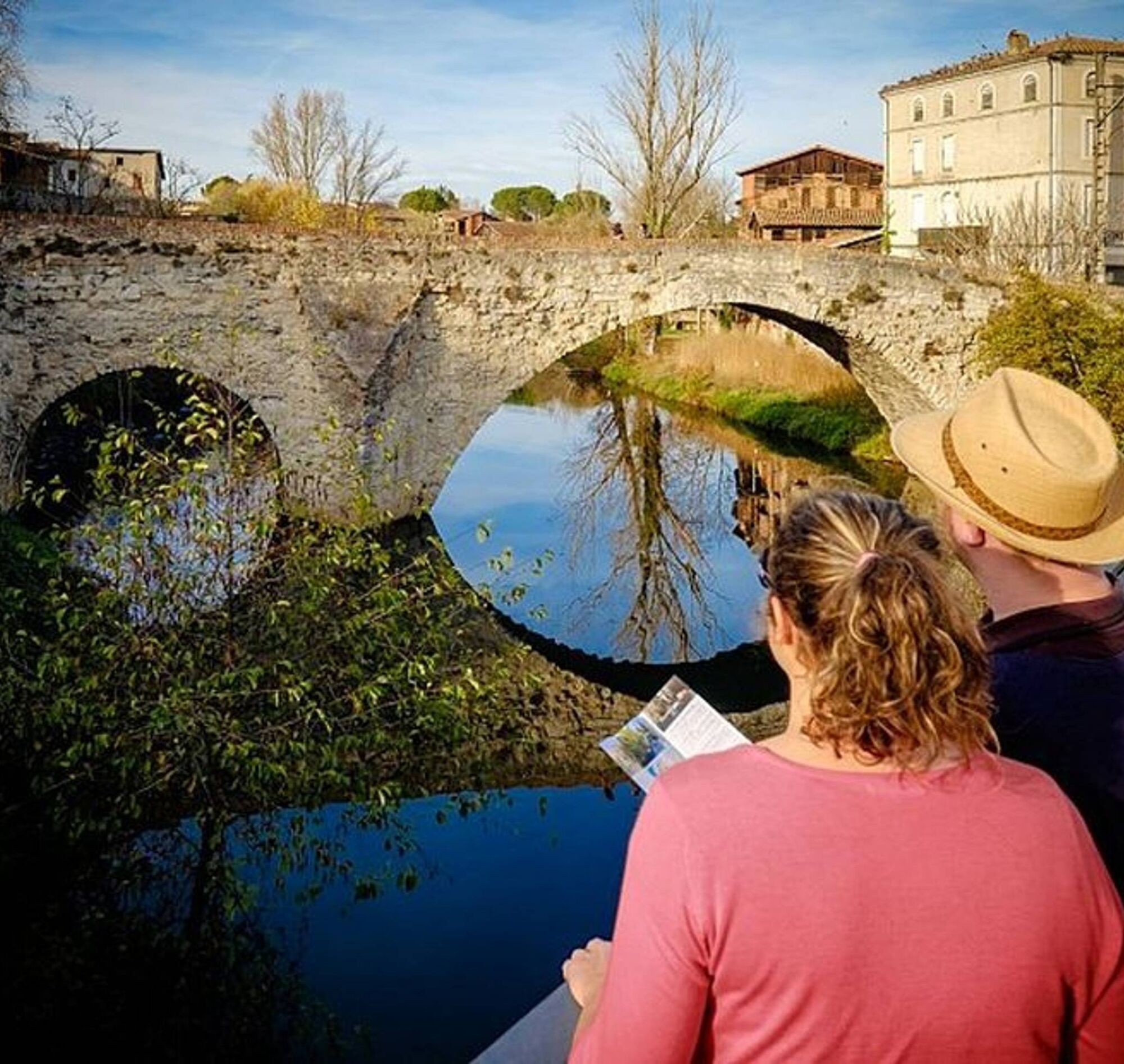
4. Pont Vieux - Classified as a Historical Monument. Built in 1244 to allow the fortified town to expand across the Dadou River, it enabled the establishment of early medieval tanneries along the river in the St-Jean district. For hygiene reasons, tanneries were constructed outside the city walls during the Middle Ages.
5. Rue Médiévale de Panessac - Here we are in the heart of the Middle Ages. This street, one of the most typical in the department, features narrow timber-framed facades. Formerly, "pountets" connected some of the houses.
6. Hostellerie du Lyon d’Or - Listed as a Historical Monument. It is one of the oldest oak timber-framed buildings in the South of France. Its facade, with its two levels of timber framing and distinctive St-Andrew's crosses typical of the 15th century, and its projecting upper story over a ground floor made of well-dressed sandstone, stand out.
7. A Beautiful Shop - A testament to the commercial life of the town. Spinning mills, drapery, hat-making, shoemaking, leatherworking, and furriery have enlivened the town since the medieval period, complementing the trades of the time. In this very narrow alley connecting the Place du Château, where poultry markets were held, and Place Mercadial, the site of the weekly market, one can admire a rare beautiful drapery shop. The term "trié sur le volet" (handpicked) comes from the practice of displaying goods on slightly raised shutters.
8. Pastel and "Soleilhous": Since the mid-15th century, the Pays de Cocagne (named after the "coque" in Occitan, referring to the hand-worked and molded pastel leaves) in the golden triangle of Albi-Toulouse-Carcassonne has experienced significant economic expansion linked to its cultivation and trade. Graulhet was a pastel center and had a small pastel port for transit on the Dadou River, via the Tarn and Garonne to supply England and Spain. The pastel plant produced a pigment known as "blue gold" that provided seven primary shades of blue sought for dyeing fabrics and painting. While strolling through the town, you can see some picturesque open drying sheds, the "soleilhous," where pastel was dried.
9. Pigeonnier du Pré de Millet - A beautiful "foot of mule" type dovecote, where bird droppings were once used as fertilizer for vineyards and pastel cultivation.
10. Mediatheque M. YOURCENAR - A fine example of a mix of traditional materials and innovative contemporary elements.
11. Château de Crins - Residence of the Counts of Aubijoux, built by Louis d'Amboise starting in 1585. It features the characteristics of Renaissance residential castles, with a recessed facade flanked by two towers and two wings. In the 1970s, part of it was demolished to accommodate the Crins school.
Easy
Priljubljeni izleti v okolici
Garlic Trail
svetlobaPohodništvo 7.07 km- 5.0
Sentier des crêtes
srednjaPohodništvo 11.3 km Sentier des coteaux
svetlobaPohodništvo 10.0 kmLe circuit du pas du Loup
svetlobaPohodništvo 9.89 kmRidge Loop
svetlobaPohodništvo 5.69 km- 5.0
Three Lakes Trail - Sentier des trois lacs
svetlobaPohodništvo 8.22 km Oenorando® La Birado
svetlobaPohodništvo 7.76 kmLe circuit des Devèzes
svetlobaPohodništvo 9.99 kmLe circuit boisé de la Capelle
težkoPohodništvo 18.6 kmLou camin San Jordi
svetlobaPohodništvo 8.85 km

Pohodništvo in sledenje

Ne zamudite ponudb in navdiha za naslednje počitnice
Vaš e-poštni naslov je bil dodan na poštni seznam.